
© Cartier
© Cartier

© Cartier
Cartier Haute Joaillerie
In 1968, María Félix commissioned Cartier to create a necklace in the form of a serpent — 57 centimeters long, entirely articulated, set with 2,473 diamonds, capable of coiling around the neck with the movement of a living animal. The piece took its shape from the serpent's body, not from a jeweler's template. It remains the most precise definition of what Cartier haute joaillerie is.
The Cartier Brothers · The World As Source
The foundation of Cartier haute joaillerie is a conviction established by the three Cartier brothers — Louis, Pierre, and Jacques — who divided the world between them in the early 20th century. Louis held Paris. Pierre took New York. Jacques traveled to India, Persia, Russia, and the Far East, returning with gemstones, decorative objects, and design vocabularies that no other European jeweler had encountered. The brothers' passion for the earth and its natural beauties — their curiosity about what other civilizations produced and valued — became the engine of the house's creative identity. Cartier does not design jewelry from a fixed formal language. It designs from encounter: with stones, with cultures, with creatures, with the natural world in its most unexpected manifestations. This is what the haute joaillerie collections demonstrate each year — that the world is still producing sources of formal inspiration that no one had anticipated, and that Cartier's ateliers are still capable of translating them into precious metal and exceptional stones.
Jacqueline Karachi — artistic director of Cartier — has made this ancestral globe-trotting spirit explicit in her recent collections. "It's our turn to observe the world with a curious and open eye for what it has to offer," she has said. The statement is not modest. It is a description of a methodology that has governed the house since Jacques Cartier first arrived in India.
Beautés du Monde · The Cabinet Of Curiosities
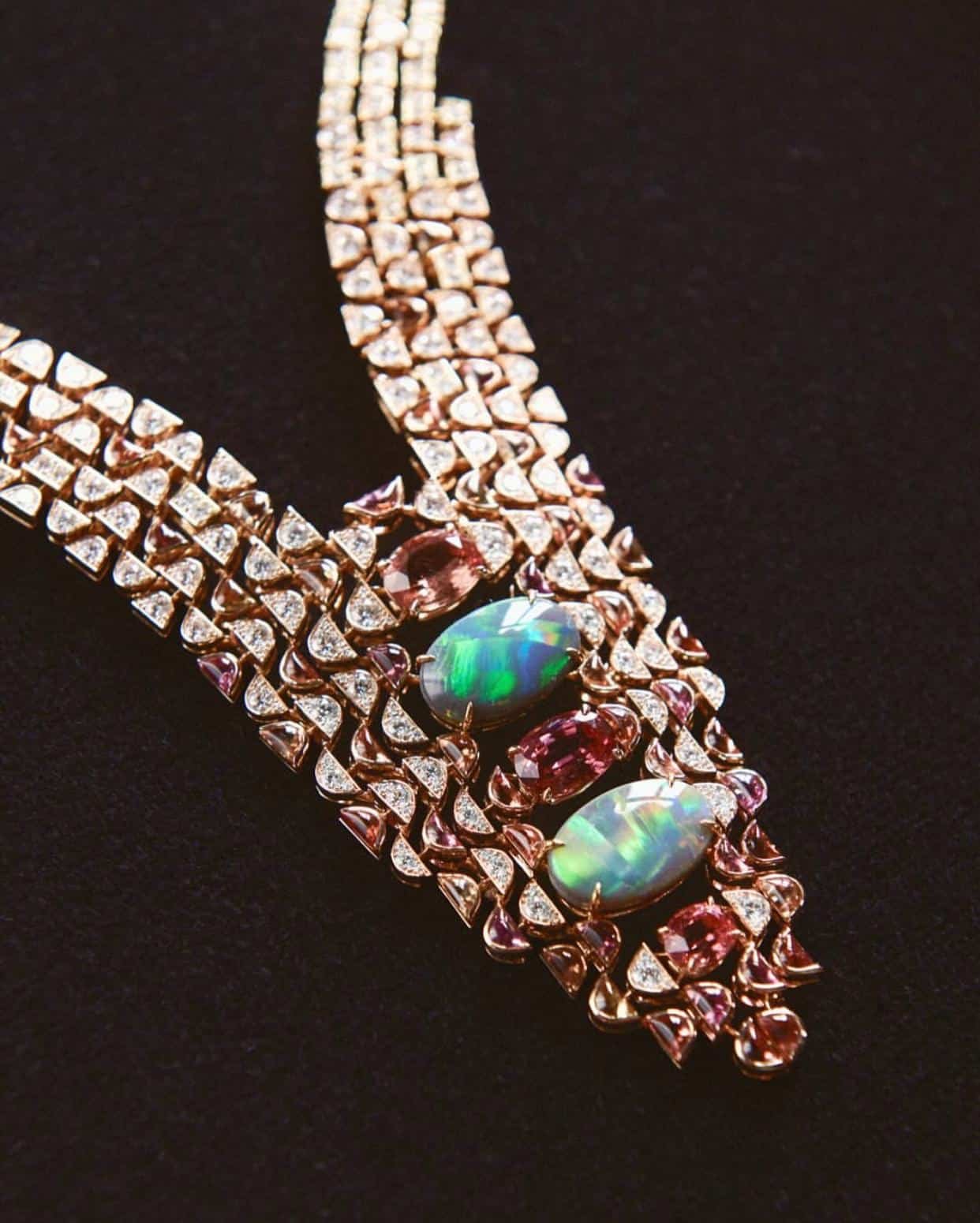
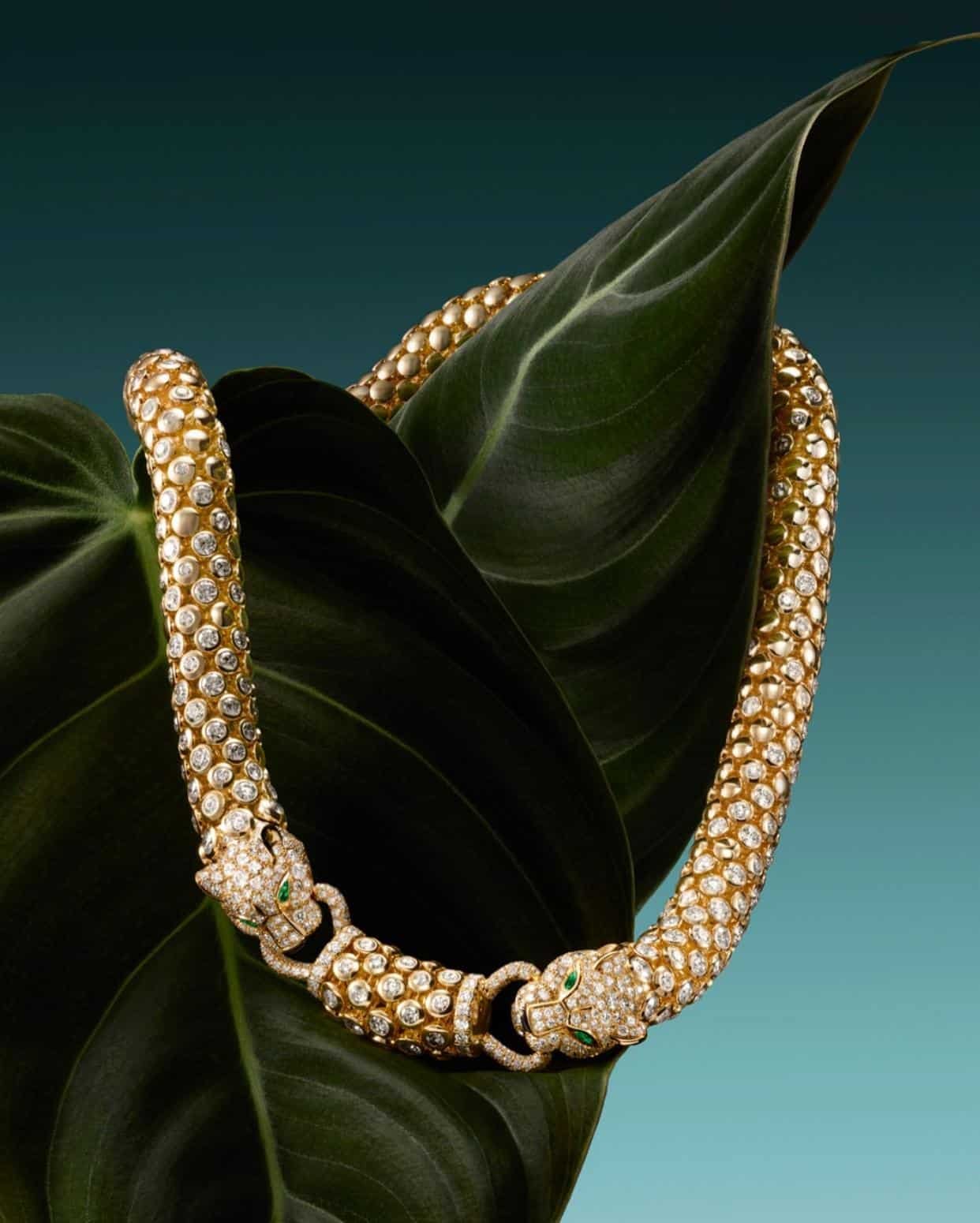
Beautés du Monde — Beauties of the World — was presented as a collection of 97 exceptional pieces: a flamboyant cabinet of curiosities assembled from the natural world and human civilization across five continents. The collection's organizing principle was curiosity: about creatures, cultures, landscapes, and geological phenomena that the house's designers had encountered and translated into precious stones and refined settings. The Iwana necklace — an abstraction of an iguana — was built around an exceptional batch of Colombian emeralds whose particular shapes suggested the creature's scales. The Tepoz necklace, evoking Amerindian arrows, was conceived from a lot of rubies whose rounded forms determined the piece's geometry. The Mahavai ring united a rare blue-tinted green diamond with a blue diamond in a toi et moi of radical contemporaneity. Two green diamonds appeared within the same collection — an almost unprecedented occurrence in a single haute joaillerie presentation. The Panthère Erindi necklace reinterpreted the panther's spotted fur at a scale and technical complexity that the house's ateliers had not attempted before.
The animal kingdom provided Beautés du Monde with its most striking pieces. The Iwana necklace began with the emeralds — an exceptional Colombian lot whose forms suggested the iguana's geometric scales, the design built outward from the stone's character. The Mizuchi ring drew on a dragon's eye, its tourmaline center surrounded by onyx worked into fine black lattice of exceptional delicacy — onyx in this form had never appeared in a Cartier haute joaillerie piece before. The Panthère Erindi necklace reinterpreted the house's most iconic animal in a new technical register. Each piece began not with a design brief but with a stone, or a creature, or a precise moment of natural encounter.
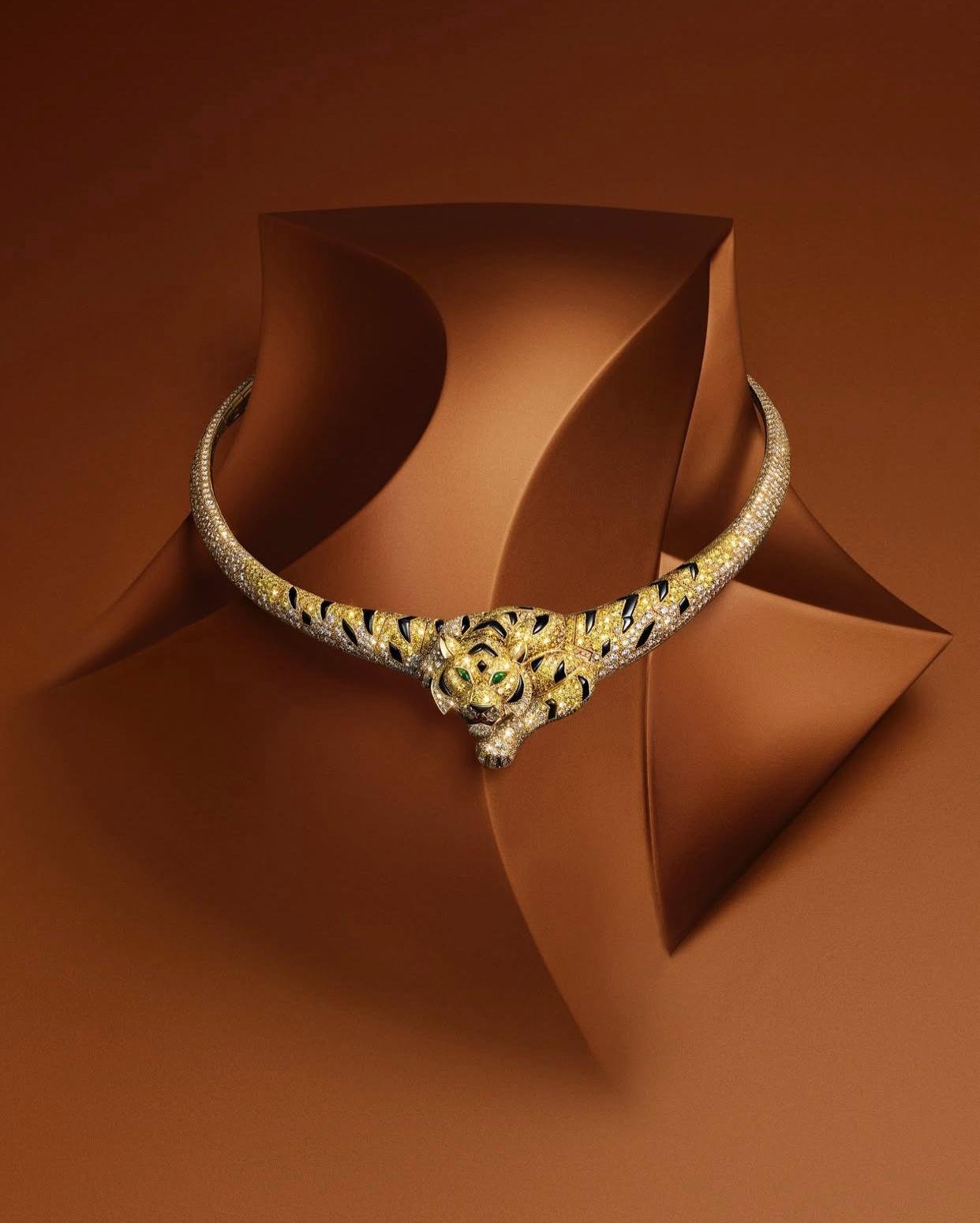
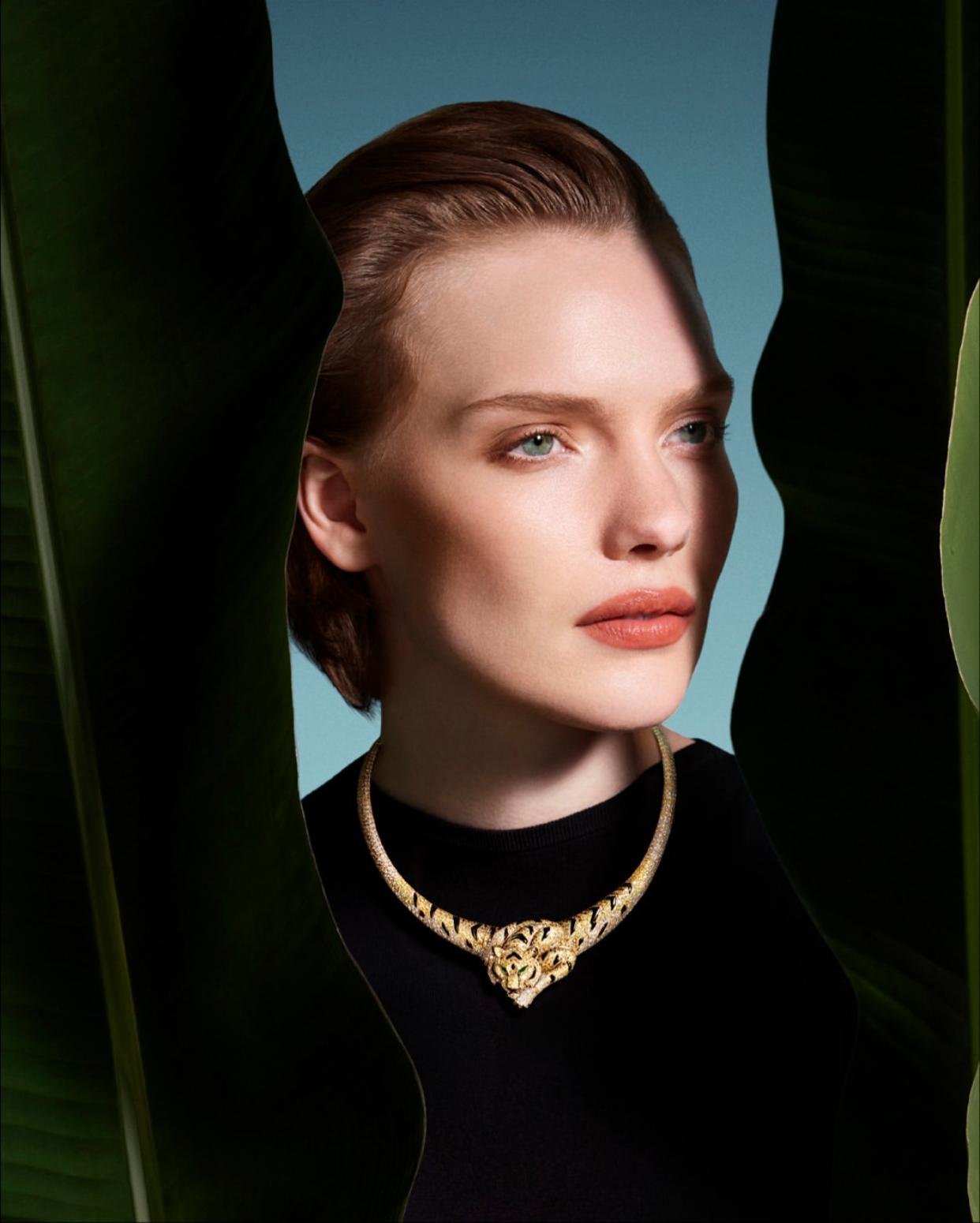
Nature Sauvage — presented in 2025 — returned to Cartier's most enduring source of haute joaillerie inspiration: the animal kingdom, and specifically the panther. The collection transformed the house's iconic fauna through unexpected geometric and sculptural treatments — wildlife brought to life through angular, precise compositions adorned with exceptional white diamonds and rare emeralds. Each piece was conceived as a museum-worthy investment, a wearable sculpture in which the animal's character was captured not through representation but through the abstraction of its movement, texture, and presence.
The Coloratura collection assembled 240 pieces around a single governing principle: that color, as it appears across the world's civilizations and natural landscapes, is the most generous source of inspiration available to a jewelry house with the curiosity to seek it out. The contrasts of Asia and the Orient, the subtle gradations of Japan, the vivid pigments of India, the tawny tones of Africa — each cultural palette was translated into specific stone combinations, specific chromatic relationships, specific formal decisions. Coloratura demonstrated that Cartier's haute joaillerie is not a house style applied to exceptional stones. It is a response to what the world actually looks like, color by color, culture by culture.
Le Voyage Recommencé — the journey resumed — revisited Cartier's savoir-faire through a fresh creative lens, exploring bold contrasts and fluid designs. Cascading aquamarines combined with vibrant tourmalines and sparkling diamonds in compositions that prioritized movement and light reflection over static grandeur. The collection's organizing metaphor — a journey recommenced — is also an accurate description of Cartier's approach to haute joaillerie: each annual collection is not a departure from what preceded it but a new chapter in the same ongoing exploration, nourished by the same fundamental curiosity about the world that Jacques Cartier brought back from Persia and India a century ago.
The Serpent necklace created in 1968 for María Félix is the piece against which all Cartier haute joaillerie is measured. The Mexican actress commissioned a necklace in the form of a serpent — not a serpent motif, but a serpent: 57 centimeters of entirely articulated platinum pavé set with 2,473 diamonds, capable of coiling around the neck with the same fluid motion as the animal itself. The piece required an unprecedented engineering solution — every link individually constructed and connected to move independently while maintaining the pavé surface's continuity. It remains on permanent display at the Cartier Collection. The Nitescence necklace from Beautés du Monde — a diamond lace structure so fine that the metal framework is invisible, centered on a 15-carat D IF diamond — is the contemporary demonstration of the same technical conviction.
The Indomptables de Cartier — the untameable ones — represent the house's most sustained haute joaillerie commitment: the transformation of the animal kingdom into wearable sculpture. The panther, introduced in the 1910s and made iconic by Jeanne Toussaint, appears across every generation of the house's haute joaillerie in new technical registers. The crocodile. The serpent. The eagle. Each animal is not merely a motif but a formal problem — how to capture the specific quality of a creature's movement, texture, and presence in precious metal and stones, at a scale and with a precision that makes the object worth spending months to produce. Indomptables is the most continuous thread in the house's haute joaillerie history.
The Iwana necklace began not with a design
but with a batch of Colombian emeralds
whose shapes suggested the scales of an iguana.
At Cartier, the haute joaillerie piece
always begins with the stone.
The design follows from what the stone already is.
Cartier's haute joaillerie is produced in the Paris ateliers by craftsmen whose specific skills — en tremblant setting, grain setting, invisible setting, articulated construction, the platinum wirework that makes stones appear to float — have been developed over generations within the house. The technical vocabulary of Cartier haute joaillerie is not borrowed from the broader industry. It was invented within these workshops, refined piece by piece, collection by collection, over more than a century. The Serpent necklace's fully articulated pavé construction required a technical solution that had not existed before the commission. The Mizuchi ring's onyx lattice was achieved at a fineness and complexity that the material had not previously been worked to in a haute joaillerie context. Each collection extends the technical frontier that the previous one established. The ateliers do not produce what is already possible. They produce what the current collection requires — and then what was impossible becomes the new standard.
653 Fifth Avenue · The Mansion · New York
Cartier's haute joaillerie is presented at the Fifth Avenue mansion — the five-story Renaissance Revival townhouse at the corner of 52nd Street, acquired by Pierre Cartier in 1917 in exchange for a natural pearl necklace and never sold since. The haute joaillerie pieces are shown by appointment on the upper floors, in a setting whose architecture — intimate, residential, entirely at odds with the grandeur of the pieces it contains — reflects the Cartier position that jewelry of this order should be encountered privately rather than displayed publicly. The mansion does not announce itself. The jewelry does not need it to. New York collectors who have been coming to this address for decades understand that the appointment is the beginning of the experience, not a formality preceding it.
653 Fifth Avenue · New York, NY 10022 · Corner of 52nd Street
Haute joaillerie by appointment · Upper floors of the Cartier Mansion
Beautés du Monde · Nature Sauvage 2025 · Le Voyage Recommencé
Coloratura · Indomptables de Cartier · Pluie de Cartier
Acquired 1917 · Pierre Cartier · Founded Paris 1847
cartier.com/en-us/high-jewelry
Jacques Cartier traveled to India, Persia, and Russia
and brought back what he found there.
The house has been returning ever since —
to the iguana's scales, to the dragon's eye,
to the Colombian emerald that already knew
what it wanted to become.
The world is still producing sources of beauty
that no one had anticipated.
Cartier is still paying attention.
© Cartier
© Cartier
© Cartier

© Cartier

© Cartier

© Cartier
© Cartier
© Cartier
CARTIER
© Cartier