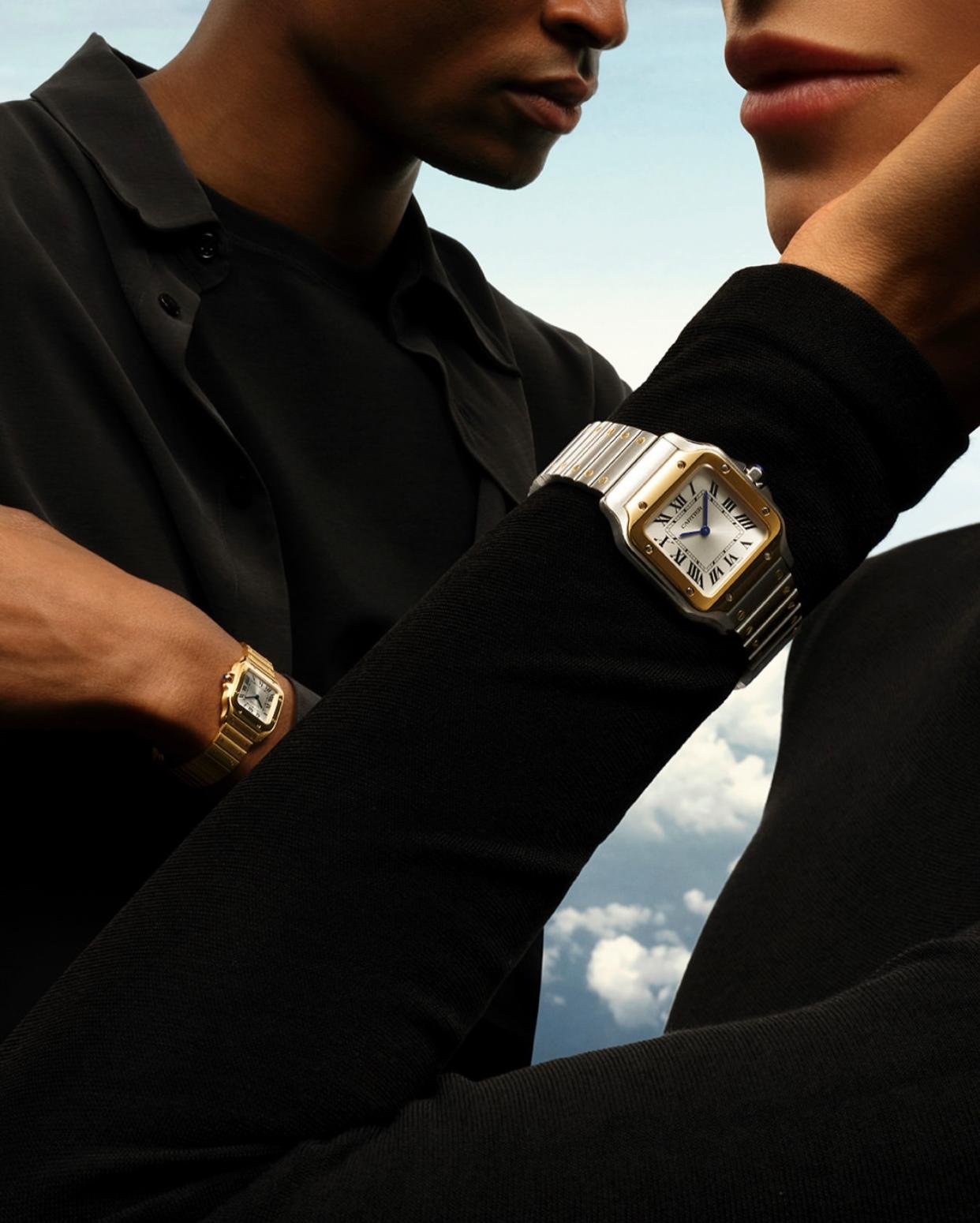
© Cartier

© Cartier

© Cartier
Cartier
In 1904, Alberto Santos-Dumont asked Louis Cartier for a watch he could read without taking his hands off the controls of an aircraft. What Cartier designed that year — a square case, an exposed bezel, a wrist strap instead of a chain — became the first pilot's wristwatch in history. New York has been wearing it ever since.
The House · Paris · 1847 · A Different Idea Of Time
Cartier does not make watches the way watchmakers make watches. It makes watches the way jewelers think about objects — with an obsession for form, for the relationship between a case and a wrist, for the way a dial communicates before the hands have moved. Louis Cartier understood something that the Swiss industry took decades to absorb: that a watch worn on the body is also a statement about the body, about proportion, about how one wants to be seen moving through a room. The Santos was the proof. The Tank — designed in 1917, inspired by the Renault FT tank's aerial profile — was the confirmation. Over a century later, both remain in production. Neither has required fundamental revision. That is the rarest thing in watchmaking.
Santos de Cartier · The World's First Pilot's Watch · Still Flying
The Santos de Cartier is the oldest wristwatch collection in continuous production. It was designed in 1904, relaunched in 1978, and comprehensively reimagined in 2018 — when Cartier curved the bezel's edges, integrated the bracelet more seamlessly into the case, and introduced the QuickSwitch system: a mechanism that allows the wearer to swap between the steel bracelet and a leather strap in seconds, without tools. The result is a watch that reads as sporty on the bracelet and as refined on leather — the same object in two registers, depending on the hour.
The current Santos de Cartier large model measures 40.2mm, powered by the in-house Calibre 1847 MC. The Santos-Dumont — the slimmer, dress-oriented sibling — runs on the manually wound Calibre 430 MC, just 2.1mm in height, and measures 43.5mm x 31.4mm in its large version. The 2024 Santos de Cartier Dual Time added a second time zone at 6 o'clock with an AM/PM indicator — a natural evolution for a watch born for aviation. The Santos-Dumont Skeleton, driven by the Calibre 9629 MC with a micro-rotor shaped like Santos-Dumont's aircraft the Demoiselle, remains one of the most architecturally considered skeleton watches in contemporary horology.
The everyday Santos — the one that works at a desk and at a dinner table, on the steel bracelet and on alligator leather. Roman numerals on a silver or sunray dial. Seven-sided faceted crown set with a blue synthetic spinel. The exposed bezel screws that have defined the design since 1904 — functional in origin, now inseparable from the aesthetic. The QuickSwitch system means one watch becomes two, depending on what the day requires.
Introduced at Watches & Wonders 2024 — a Santos built for those who live across time zones. The second time zone subdial at 6 o'clock carries a 12-hour display and a day/night indicator, integrated so seamlessly into the anthracite dial that the complication reads as part of the design rather than an addition to it. The watch Alberto Santos-Dumont would have wanted, had he ever crossed the Atlantic.
The Santos-Dumont is the dress version of the family — elongated, flat, made for a shirt cuff rather than a flight deck. The Calibre 430 MC, manually wound and just 2.1mm in its round configuration, disappears beneath a dial of Roman numerals and a slim railway minute track. Available in yellow gold, rose gold, or steel. The watch for the evening. The one that disappears into a suit and reappears exactly when it should.
The skeleton Santos-Dumont removes the dial entirely — the bridges of the Calibre 9629 MC serve as the numerals, the movement is the watch, the watch is the movement. Eight millimeters in total thickness. A micro-rotor shaped like Santos-Dumont's aircraft, the Demoiselle — a detail only visible on close inspection, addressed to those who look. Available in steel or rose gold. One of the most formally resolved skeleton watches in contemporary production.
Designed in 1917, inspired by the aerial view of a Renault FT tank crossing the fields of the Western Front. The Tank Louis Cartier is the most copied watch case in history and the least successfully imitated. Its proportions — the brancards running parallel to the case, the Roman numerals filling the corners, the sapphire-set crown — are so specific that any variation produces something that is demonstrably not a Tank. Worn by Andy Warhol, Jackie Kennedy, and three generations of those who understood that the most powerful statement a watch can make is one of restraint.
Each year, Cartier's Privé collection revisits one historical model in limited, collector-focused editions. For 2024, the spotlight fell on the Tortue — first designed in 1912, its distinctive turtle-shaped case and apple-shaped hands now reissued in platinum and yellow gold configurations, including the Tortue Monopoussoir chronograph at just 4.3mm in movement height. The thinnest chronograph in Cartier's history, available in platinum or yellow gold, limited in quantity, finished with Côte de Genève through the exhibition caseback. The watch for those who collect with intention rather than accumulation.
In 1904, Alberto Santos-Dumont needed a watch
he could read without letting go of the controls.
Cartier designed the Santos.
One hundred and twenty years later,
the exposed screws are still there.
So is the point.
The Cartier New York mansion sits at 653 Fifth Avenue, at the corner of 52nd Street — a five-story Renaissance Revival townhouse built in 1905 and acquired by Pierre Cartier in 1917 in exchange, reportedly, for a natural pearl necklace valued at one million dollars. The building has never been sold since. Inside, the watch collections are presented with the unhurried attention of a private house rather than a retail floor. The Santos, the Tank, the Calibre de Cartier, the Ronde Must — each occupies its place in a conversation about what Cartier believes a watch should be: an object of permanent relevance, worn on the wrist of anyone who has decided that what time looks like matters as much as what time is.
The Cartier Philosophy · Form As The First Complication
Cartier rarely competes on the ground of mechanical complexity. It competes on the ground of form — and wins. The Santos case has been more influential on the architecture of the wristwatch than any chronograph mechanism. The Tank's brancards have organized more subsequent design than any tourbillon. This is not a limitation. It is a position: that the first and most demanding complication in watchmaking is the shape of the watch itself. That a case that sits correctly on the wrist, a dial that communicates clearly, a crown that the hand finds without looking — these are achievements as serious as any grande complication. Cartier has been proving this since 1904. New York, a city with a refined instinct for what is real and what is decoration, has been agreeing ever since.
653 Fifth Avenue · New York, NY 10022 · Corner of 52nd Street
Santos de Cartier · Santos-Dumont · Tank Louis Cartier · Cartier Privé
QuickSwitch interchangeable bracelet system · In-house Calibre 1847 MC & 430 MC
The Cartier Mansion — acquired 1917 · Five-story Renaissance Revival townhouse
cartier.com/en-us
Pierre Cartier acquired the Fifth Avenue mansion in 1917
in exchange for a pearl necklace.
The building has never been sold since.
Some transactions define an address permanently.
That one defined a block.
© Cartier
© Cartier

© Cartier

© Cartier

© Cartier

© Cartier

© Cartier
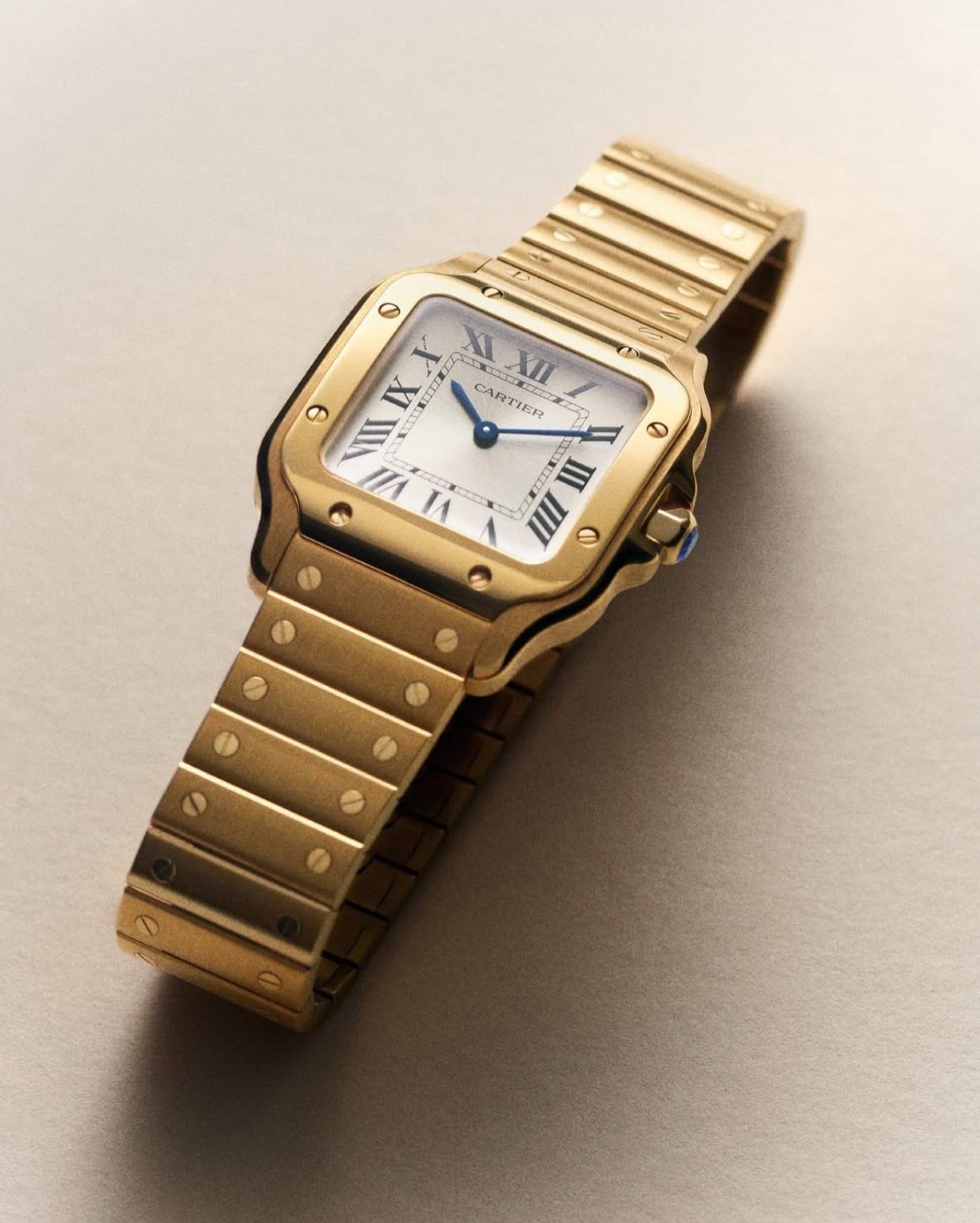
© Cartier
CARTIER
© Cartier