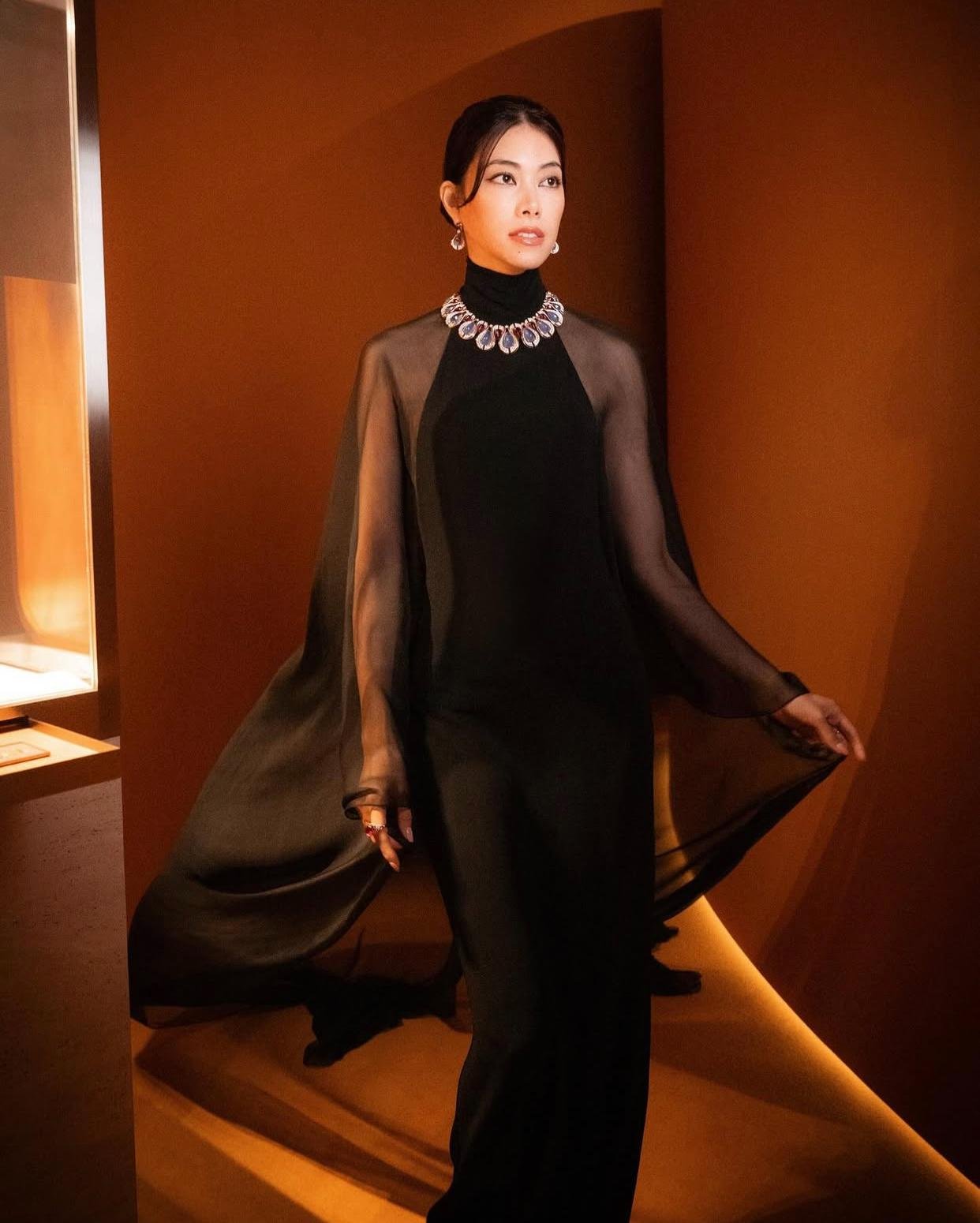
© Bvlgari
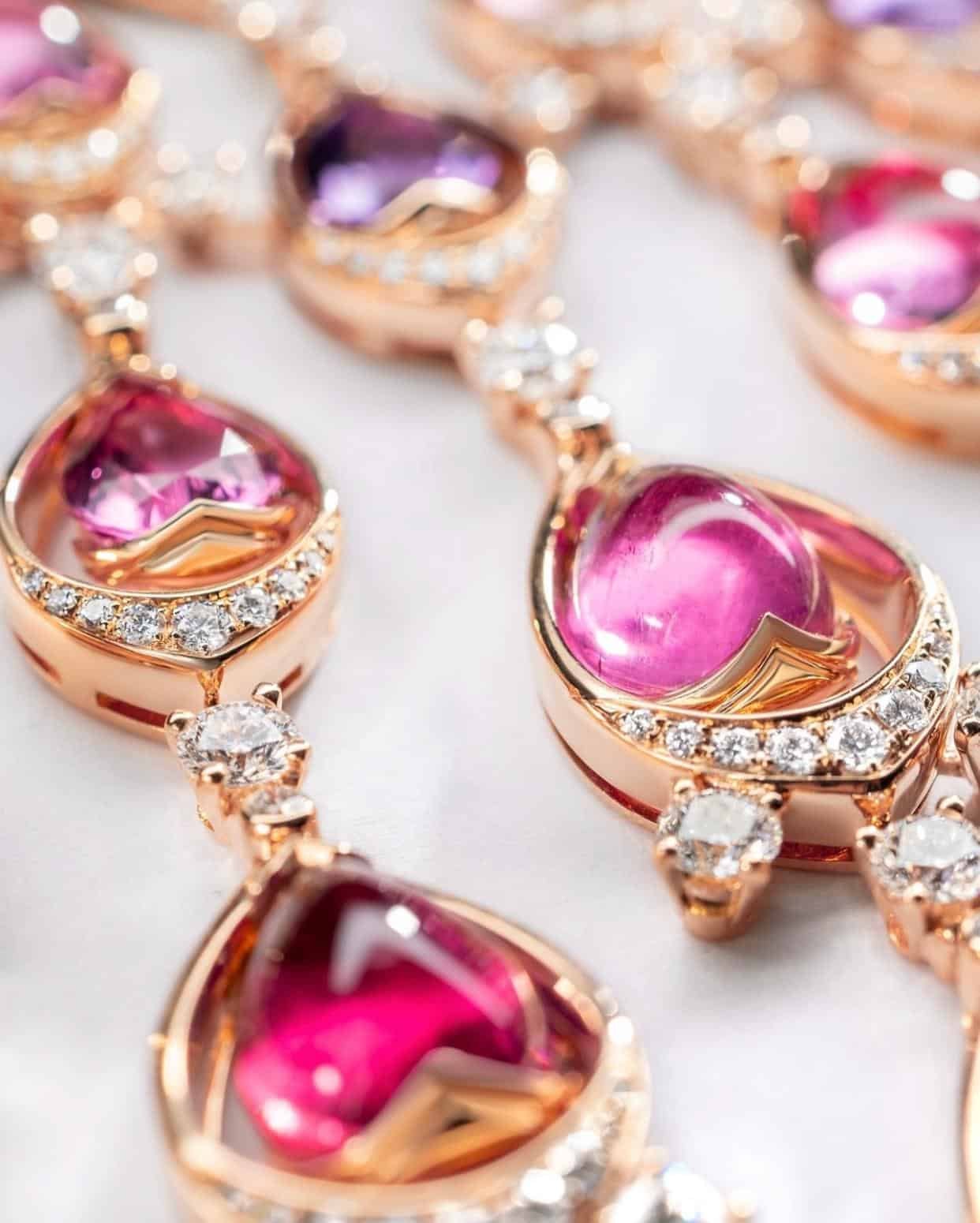
© Bvlgari
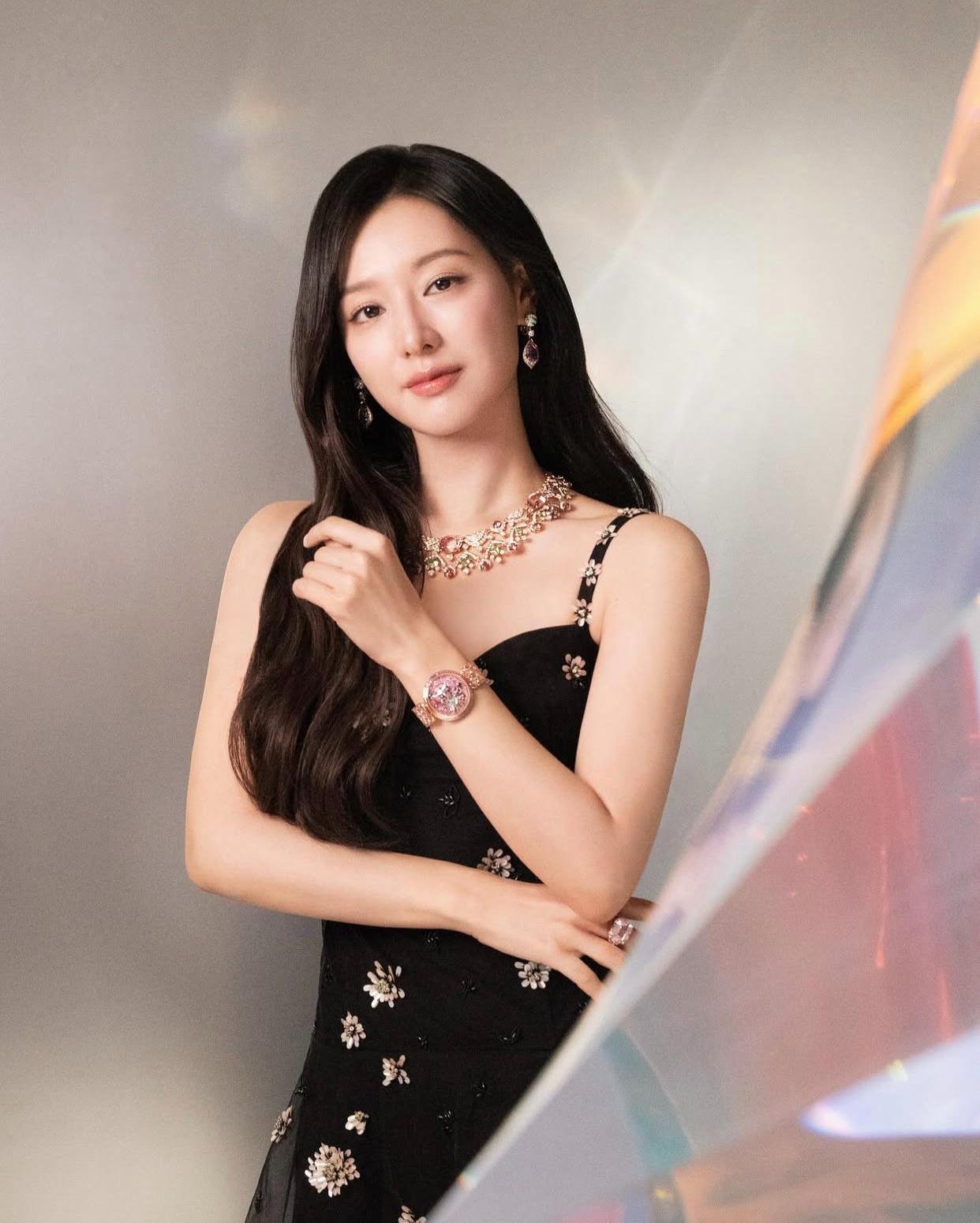
© Bvlgari
Bvlgari Haute Joaillerie
Lucia Silvestri, creative director of Bvlgari Jewellery, woke before dawn one August morning and walked through Rome while the city was still empty — discovering the sculptures of Bernini, the façades of Borromini, the exuberant theatricality of the Baroque. From that walk came an entire collection. This is how Bvlgari works: through direct encounter with Rome, and with the stones themselves.
Lucia Silvestri · The Creative Director · The Stone Hunter
Lucia Silvestri has been at Bvlgari for over forty years. She is not a designer in the conventional sense — she is, as the house describes her, a stone hunter: a woman who travels to mines, to gem markets, to auction houses in Geneva and New York and Bangkok, personally selecting the exceptional stones that will anchor each haute joaillerie collection before a single setting has been conceived. The stone comes first. The design follows from the stone's particular color, cut, character, and size. This inversion of the usual jewelry design process — starting with the gemstone rather than with a formal idea — is the defining characteristic of Bvlgari haute joaillerie. It produces pieces in which the stone is not subordinate to the design but is, emphatically, the point.
Each haute joaillerie collection takes a minimum of one year to produce from initial conception to final execution. The collections are presented annually at events in Rome — in the Eternal City's most significant architectural spaces, as a deliberate statement that the jewelry and the city are inseparable. The pieces are one-of-a-kind or extremely limited. Prices are disclosed only to qualified buyers. What Bvlgari shows in its haute joaillerie is not what it sells broadly. It is what it is capable of when given the finest stones, unlimited time, and no constraint other than the quality of the result.
Rome As Source · The Eternal Inspiration
Every Bvlgari haute joaillerie collection is rooted in a specific encounter with Rome — its architecture, its mythology, its art history, its sensory landscape. This is not a marketing narrative. It is a methodological position: that the most vivid design language available to the house is the city that formed it, and that returning to Rome with fresh eyes each year produces designs that no other house can replicate. The Baroque period — with its exuberant sculptural surfaces, its theatrical deployment of light and shadow, its refusal of restraint — has been particularly generative for Bvlgari, producing the Barocko collection as one of the most technically demanding and visually overwhelming series the house has ever assembled. The Mediterranean gardens, the mythological creatures of ancient Rome, the fireworks of an Italian summer night — all have served as source material for collections that translate these encounters into precious stones set in platinum and gold.
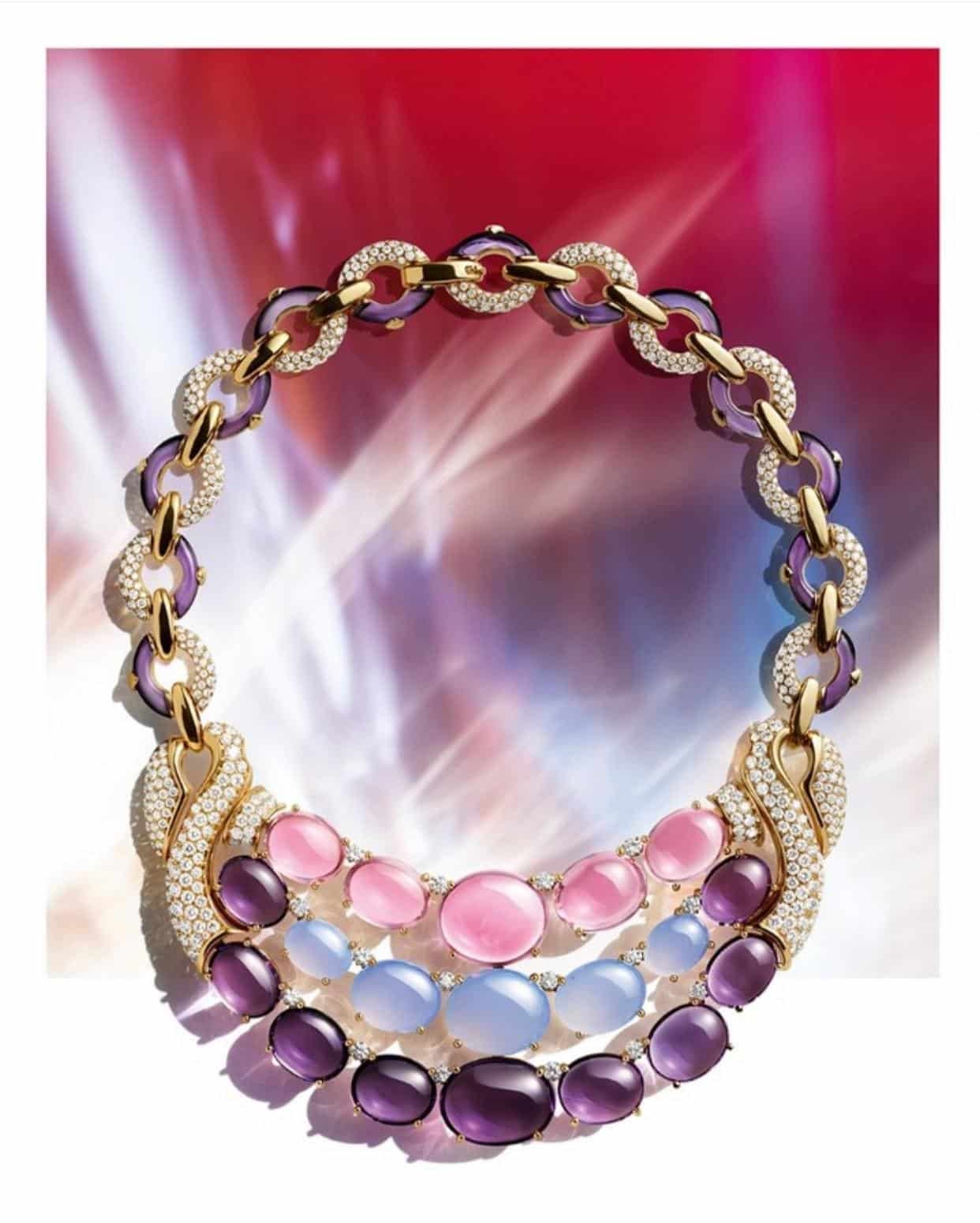
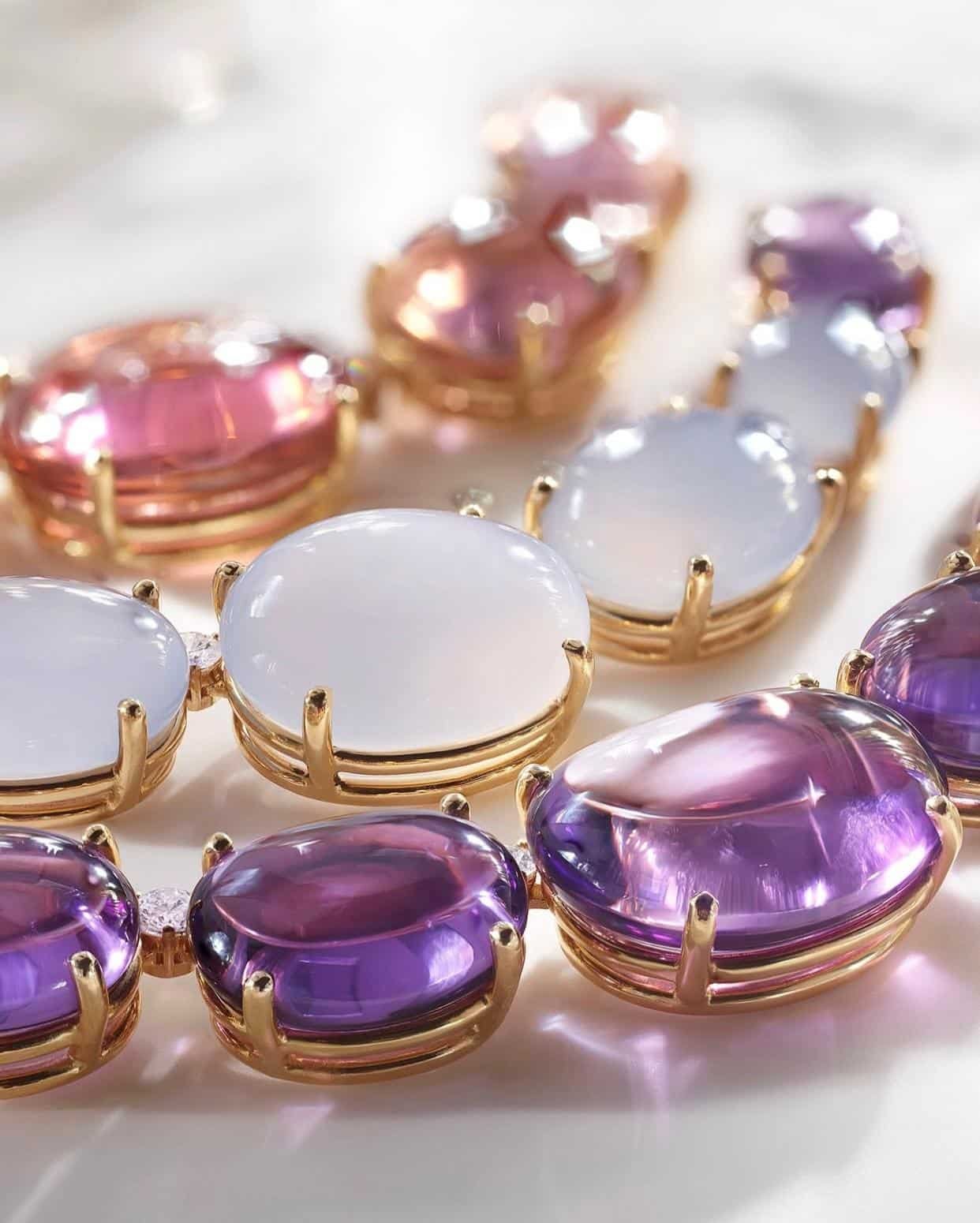
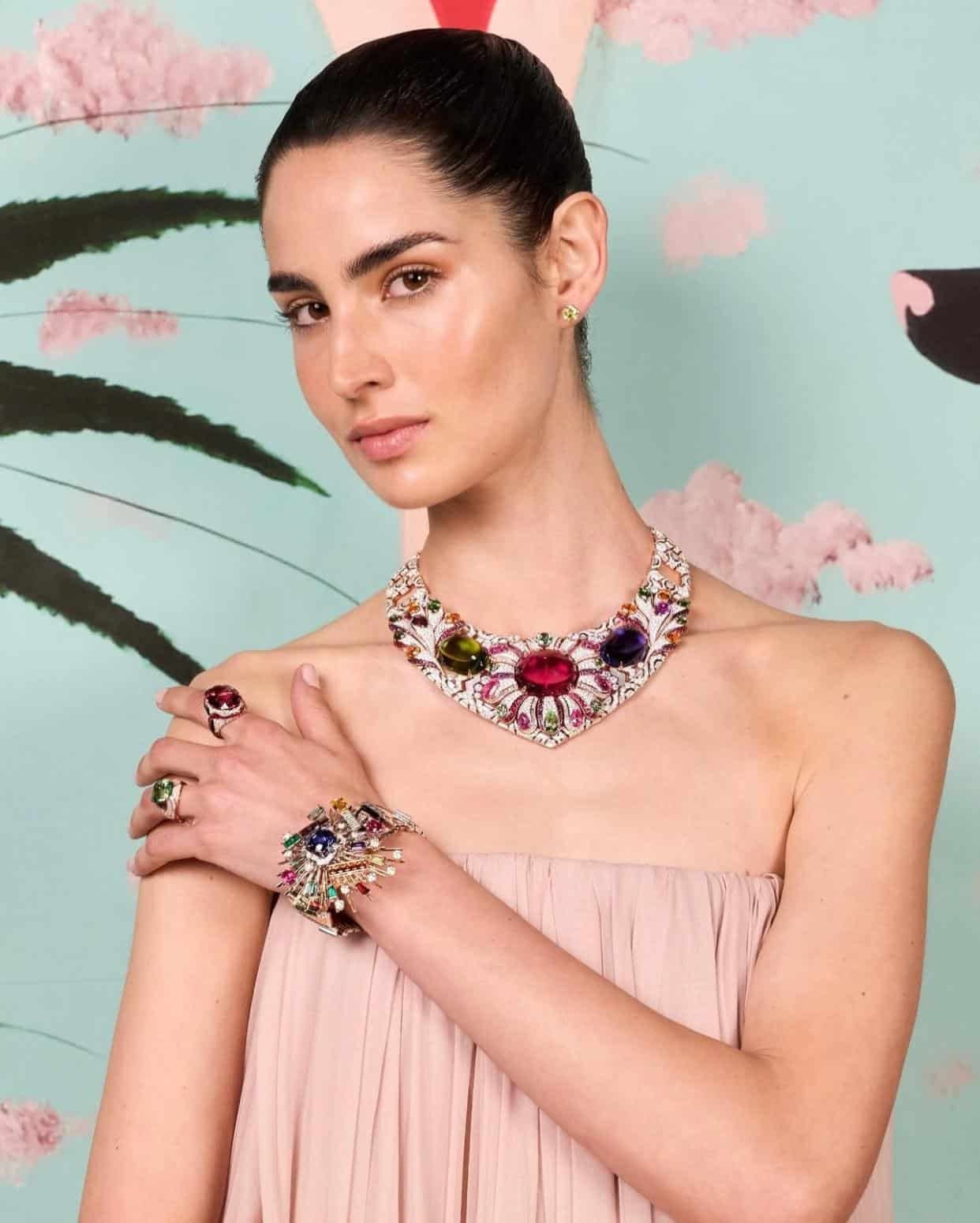
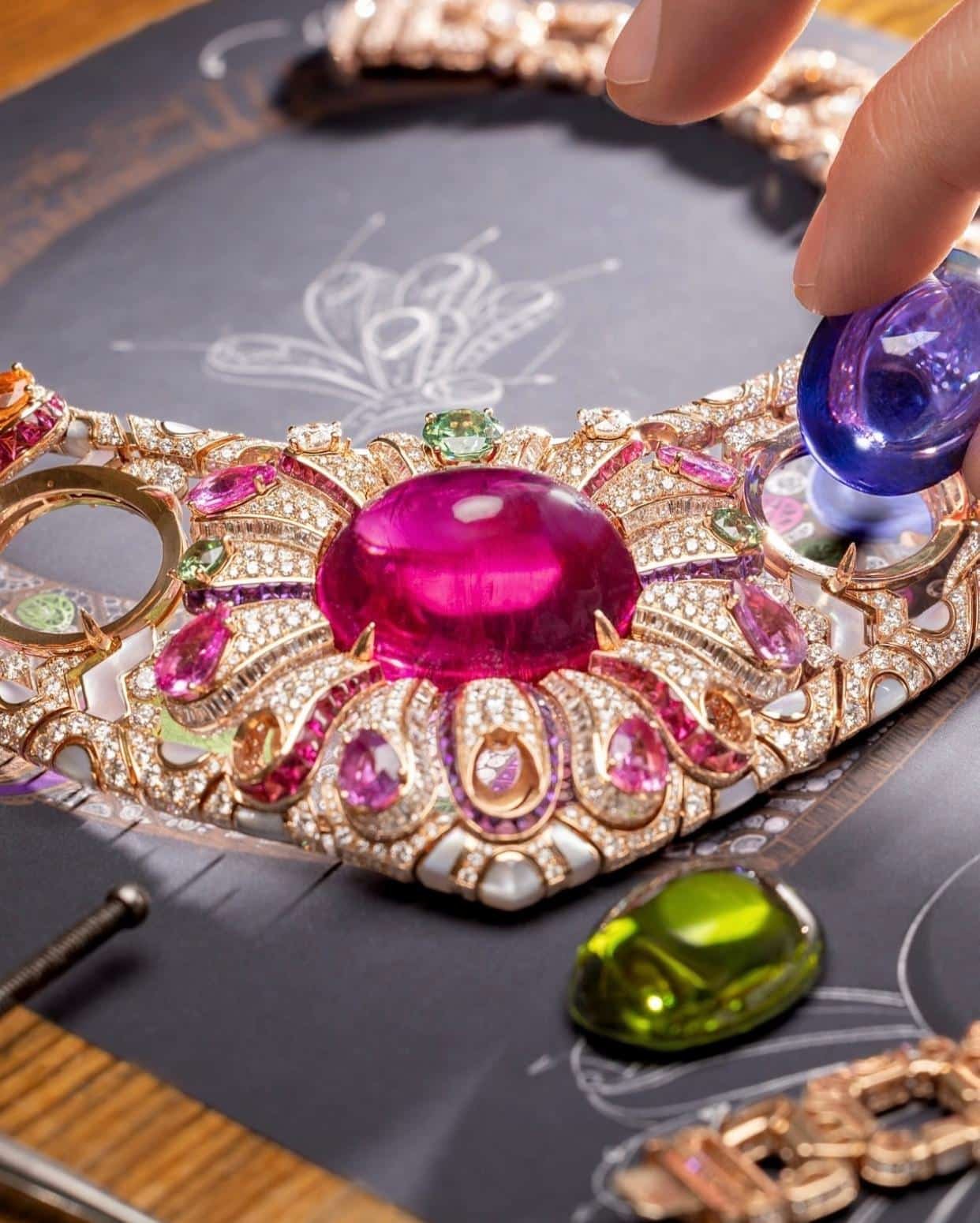
The Barocko collection took its inspiration from Lucia Silvestri's early-morning walk through Rome — the Fountain of the Four Rivers by Bernini, Sant'Agnese in Agone by Borromini, the Horti Farnesiani on the Palatine Hill. The collection's defining pieces included the Sapphire Lace necklace — an oval 28-carat Burma sapphire surrounded by 381 diamonds — and the Rosso Caravaggio necklace, centered on a rare 10-carat Mozambican cushion ruby, requiring 1,500 hours to complete and equipped with a mechanism allowing it to be worn as two separate necklaces. The Cabochon Exuberance necklace — inspired by the 16th-century Farnese Gardens — combined tanzanites, tourmalines, rubellite, aquamarines, emerald beads, and 131 diamonds, requiring 700 hours of craftsmanship. Barocko is the direct translation of Rome's most theatrically ambitious architectural period into wearable form.
The Aeterna haute joaillerie collection — presented in 2024 — drew from the concept of eternity and the Eternal City simultaneously, producing both jewelry and high jewelry watches of exceptional complexity. The Fuochi d'Artificio Manchette — inspired by an Italian summer night illuminated by fireworks — required more than 1,450 hours of fabrication: a semi-rigid cuff in rose gold and blue titanium, colored precious stones set in radiant starburst patterns, hand-cut onyx inserts. The Fenice Octo Roma Secret Watch featured a phoenix in brilliant-cut blue, purple, and pink sapphires, aquamarines, rubies, and garnets in a graduated palette. The Serpenti Misteriosi Chimera combined a rare 9.78-carat Paraiba tourmaline with a flying tourbillon and over 3,000 hours of work. These are not watches with jewelry on them. They are jewelry that contains a watch.
The Eden collection invited entry into a garden of wonders — a mythological space where the finest colored stones were arranged according to botanical logic rather than geometric convention. The Emerald Glory necklace united extraordinary Colombian emeralds with the full depth of Bvlgari's setting expertise. The Tribute to Paris necklace framed a 35.53-carat emerald with a motif inspired by the Eiffel Tower — Bvlgari's long relationship with Paris condensed into a single stone and its surround. The Emerald Ode ring gave a single exceptional stone a setting that existed solely to showcase its color and clarity. The Eden collection demonstrated Bvlgari's conviction that the finest jewelry begins with the finest stone, and that the finest stone requires nothing more than the right frame.
Bvlgari's haute joaillerie is produced in the house's high jewelry atelier in Rome, by artisans whose specific skills — stone setting, arabesque construction, mechanical integration in jewelry watches — have been developed over careers dedicated exclusively to this level of work. The production of a single major haute joaillerie piece can require between 300 and 3,000 hours of work, depending on its complexity. Each stone is selected by Lucia Silvestri personally before a design is committed to. The setting is built around the stone's particular geometry. The process is not a manufacturing process. It is a conversation between a stone and a craftsman, conducted over months, mediated by the creative director's vision of what the encounter should produce.
Lucia Silvestri travels to mines, markets and auctions
to choose the stones herself — before a single design exists.
The stone comes first.
The design follows from the stone's character.
This is not a philosophy. It is a discipline.
And it produces jewelry no other house can replicate.
Bvlgari's position in haute joaillerie is distinct from that of the Parisian houses — and deliberately so. Where Place Vendôme produces high jewelry of restrained formal precision, Bvlgari produces high jewelry of Roman theatrical conviction. Large colored stones — Burma sapphires, Mozambican rubies, Colombian emeralds, Paraiba tourmalines — are preferred over the calibrated all-diamond compositions that dominate Parisian haute joaillerie. Volume is embraced rather than moderated. Arabesque motifs, cabochon cuts, asymmetric compositions inspired by Baroque sculpture — all of these are tools in Bvlgari's haute joaillerie vocabulary that have no equivalent in the French tradition. The house does not compete with Paris on Paris's terms. It competes on Rome's terms. The distinction is the reason Bvlgari haute joaillerie is recognized immediately, at any distance, in any room. It looks like nothing else because it comes from nowhere else.
New York · 730 Fifth Avenue · The Crown Building
Bvlgari's New York boutique occupies the Crown Building at 730 Fifth Avenue — the same 1921 tower that houses Aman New York and the Chanel fine jewelry boutique. The haute joaillerie pieces are presented by appointment, in a space designed to allow each one-of-a-kind or extremely limited piece the quiet and proximity that its complexity demands. New York is Bvlgari's most significant market outside Europe — a city whose appetite for jewelry that does not apologize for its scale, its color, or its ambition aligns directly with what the house has been producing since 1884. The stones Lucia Silvestri selects at auction in Geneva arrive here. The pieces assembled in Rome over hundreds of hours arrive here. They are not displayed. They are revealed.
730 Fifth Avenue · New York, NY 10019 · Crown Building
Haute joaillerie by appointment
Barocko · Aeterna · Eden · Animali Fantastici · Annual collections
Lucia Silvestri — Creative Director, Bvlgari Jewellery
High jewelry atelier Rome · Founded 1884 · LVMH Group
bulgari.com/en-us/collection/high-jewellery
Lucia Silvestri woke before dawn and walked through Rome
while the city was still empty.
She saw Bernini's fountains and Borromini's facades
and returned to her studio to design Barocko.
Bvlgari haute joaillerie begins this way —
always with Rome, always with the stone,
always with an encounter that no other house can have.
© Bvlgari
© Bvlgari
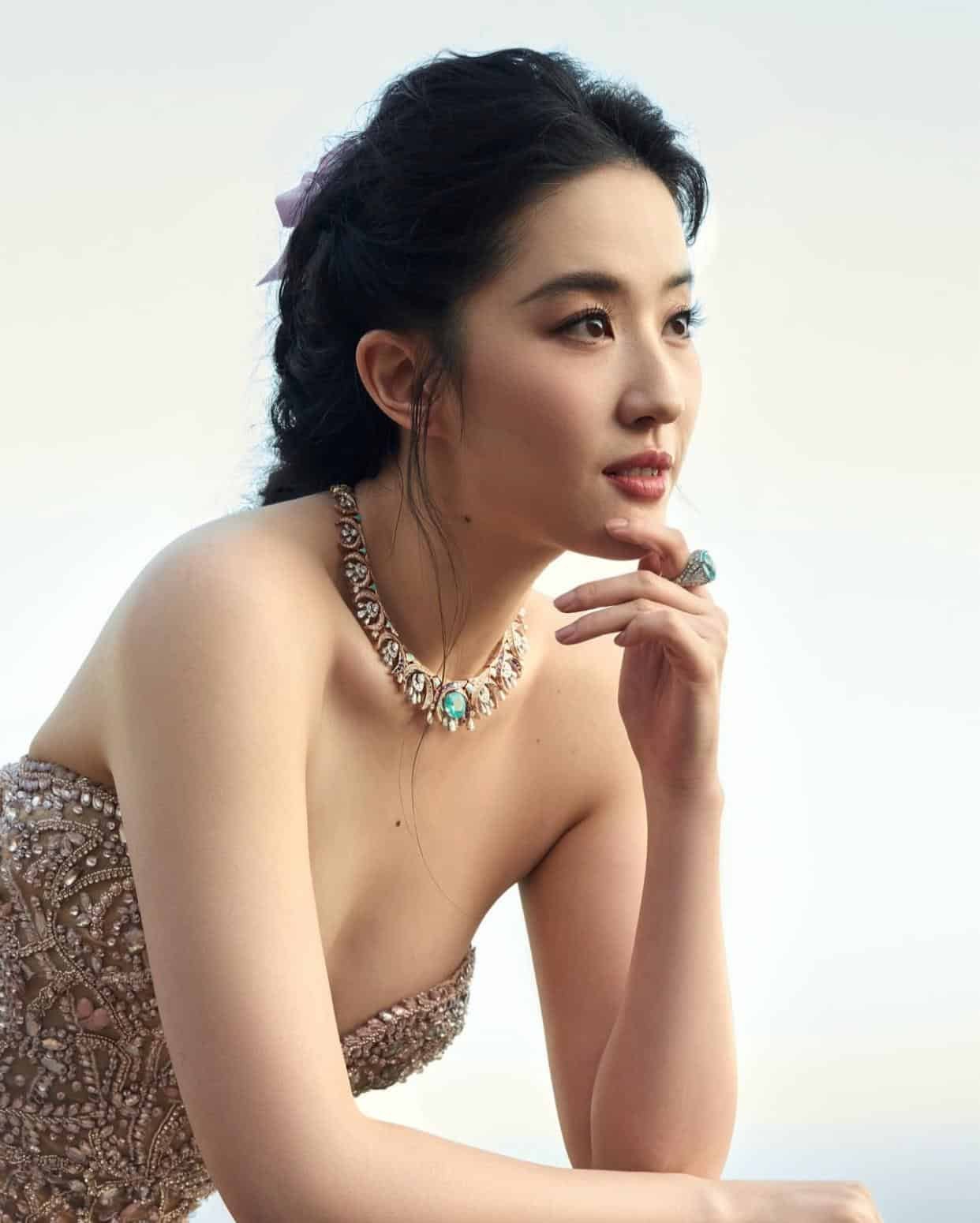
© Bvlgari
© Bvlgari

© Bvlgari
© Bvlgari
© Bvlgari
© Bvlgari
© Bvlgari
© Bvlgari
BVLGARI
© Bvlgari