
© Stella McCartney

© Stella McCartney

© Stella McCartney
Stella McCartney
In 1999, Stella McCartney bought a multipack of Hanes tank tops the day before the Met Gala. She studded them, added ribbons, spelled out "Rock Royalty" in diamante. She called Liv Tyler — daughter of Aerosmith's Steven Tyler. They arrived together at the Rock Style gala wearing their fathers on their chests. "It wasn't really appropriate," Tyler said later. "It was very cool and rebellious of Stella." She was twenty-seven and the creative director of Chloé. It was the most honest thing anyone wore that evening.
London · 1971 · Born Into Two Worlds · Raised In One
Stella Nina McCartney was born in London in September 1971. Her father is Paul McCartney — Beatle, composer, working-class Liverpudlian made into a global icon. Her mother was Linda Eastman McCartney — American, Park Avenue-raised, who left her privileged New York life to tour with rock stars, who became a photographer and an animal rights activist and a vegetarian whose commitment to those convictions she passed, entirely intact, to her daughter. Stella was raised vegetarian. She spent her childhood riding horses on a remote Scottish farm and hiking in Arizona. The combination — rock royalty heritage and a mother who cared deeply about the earth and its creatures — produced a designer who has described herself as having "a very specific point of difference that I don't share with any other fashion designer or any other fashion house." She graduated from Central Saint Martins in London in 1995. By 1997 she was creative director of Chloé in Paris — where she wore the 1999 Met Gala outfit she had assembled from a pack of Hanes tanks. By 2001 she had launched her own house, in partnership with Kering. She has not used leather, feathers, fur, or skins in any product since the first day. The industry called her an "eco weirdo." She continued.
Twenty-Five Years · One Conviction · Never Compromised
Stella McCartney launched her label in 2001 under a 50-50 joint venture with Kering. She bought Kering's stake back in 2018. In 2019 she entered a partnership with LVMH, Bernard Arnault taking a 49% minority stake and appointing her special adviser on sustainability — she was the first designer to whom Arnault, publicly known for opposing climate activism, had voluntarily subordinated his commercial interests to an ethical position he did not fully share. She co-founded the $200 million Collab SOS fund for climate solutions. She met world leaders at the G7 and at the UN Climate Change Conference. In 2010, she banned PVC from her label — a move that was later adopted by every Kering brand, from Saint Laurent to Balenciaga. In 2025, she repurchased LVMH's 49% stake and became fully independent, while remaining an adviser to Arnault and his executive team on sustainability. "I'm a very independent person," she said, "and it just became the right time for me." That same year, the French government awarded her the Légion d'honneur. She is fifty-four years old. She has never used a single piece of animal skin in any product she has made. The industry that called her an "eco weirdo" in the 1990s now describes what she has spent thirty years doing as "best practice." She describes it as "still not enough."
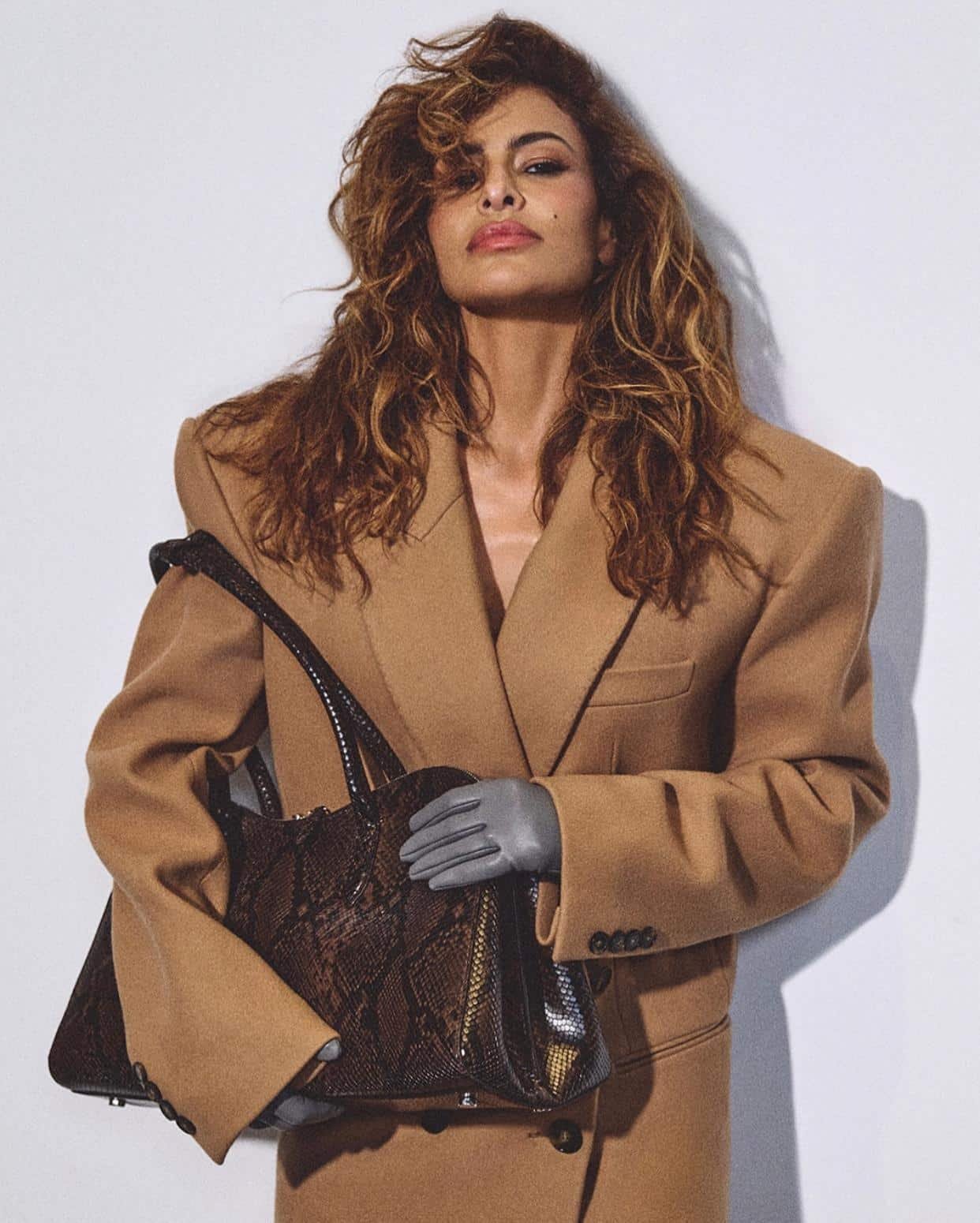
Each Stella McCartney collection is organized around two simultaneous ambitions that most houses treat as mutually exclusive: to be genuinely desirable and to be genuinely sustainable. The Autumn 2025 collection — "Rock 'n Roll Heritage" — reached 99% conscious materials, including YATAY® M biobased vegan croc derived from fungi mycelium, S-Wave Sport trainers in Piñayarn® (a 100% plant-based textile sourced from pineapple leaves with BioCir® Flex compostable soles), and Falabella bags in UPPEAL™ biobased vegan croc alternative. Spring 2026 deployed sequins made from recycled and bio-plastics, and seaweed-based ones grown in a laboratory. Fall 2026 — the house's twenty-fifth anniversary collection, presented in a riding hall in the Bois de Boulogne with thirteen pure Spanish horses — was built from 93% sustainable materials including 100% recycled denim, non-plastic sequins, and lead-free crystals. Helen Mirren recited the lyrics to "Come Together" on the runway as if they were a poem. Oprah Winfrey flew in for the occasion.
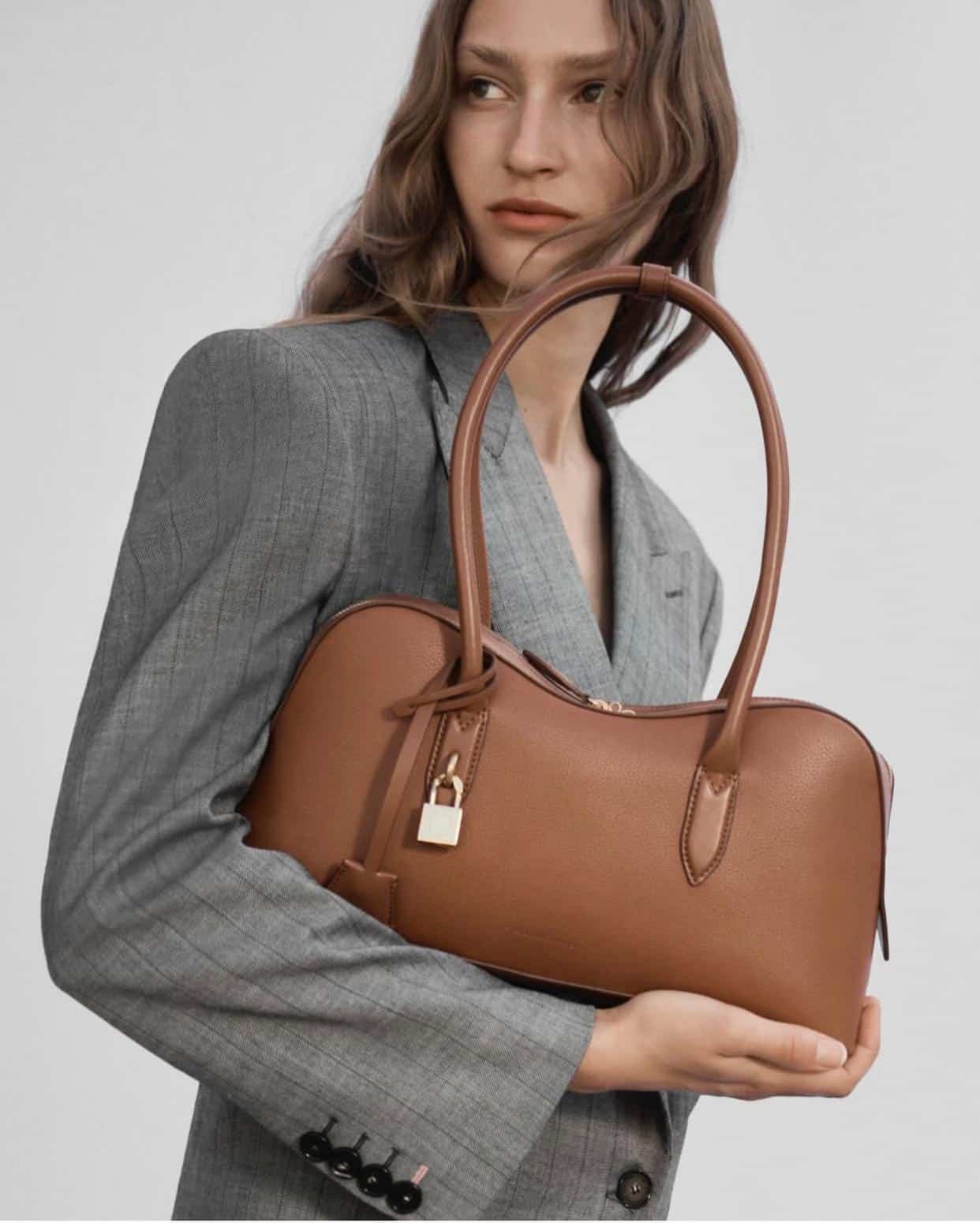
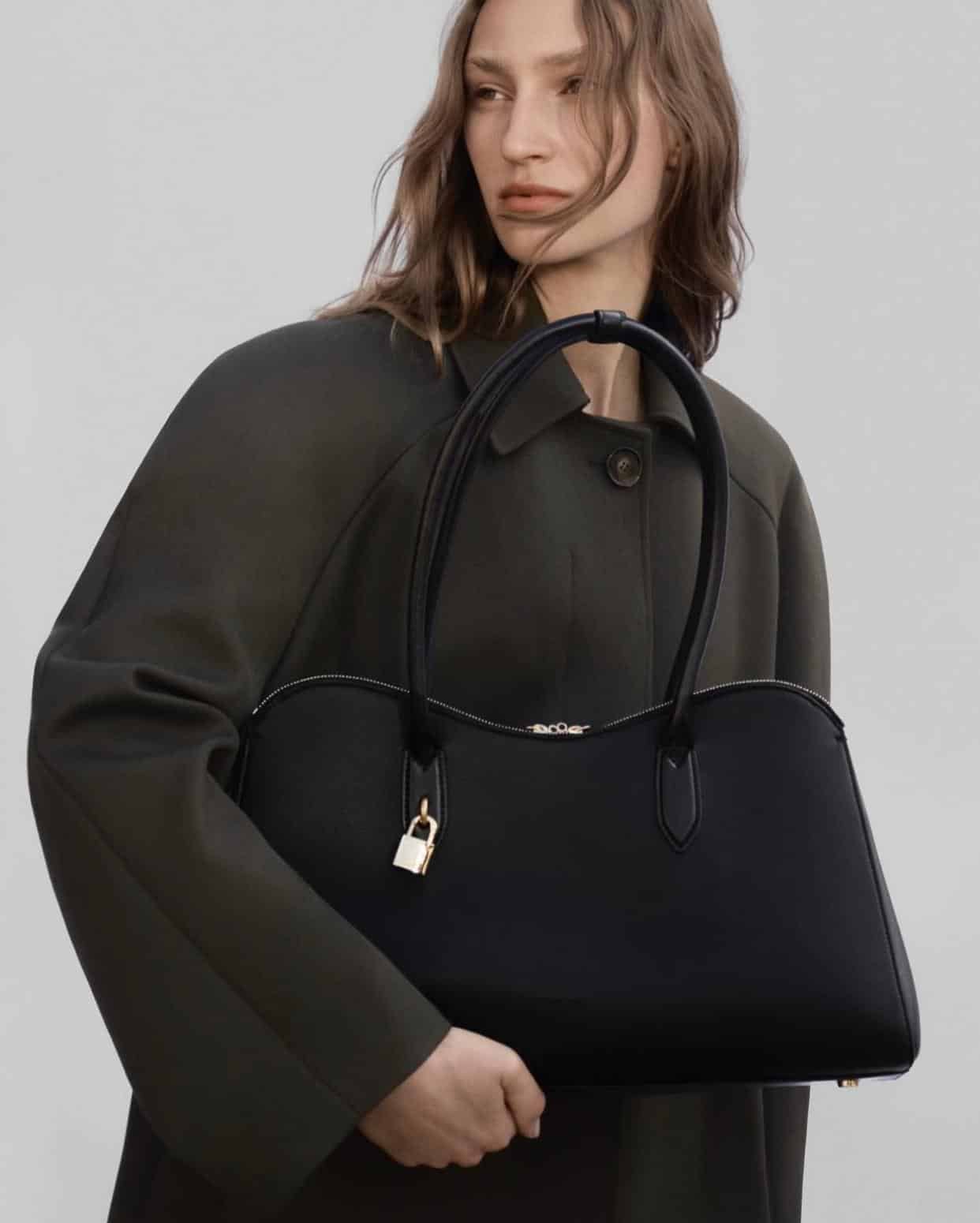
The Falabella — named for the smallest horse breed in the world — is Stella McCartney's most enduring accessory and the house's most immediately recognizable object. It has no leather. It has never had leather. The signature chain detail — which also runs through the ready-to-wear as a formal element, outlining tailoring, knits, and denim — is the Falabella's defining visual code. Each season, it appears in new materials: high-shine patent, aged effect finished by hand in Italy, biobased alternatives to croc, organic cotton canvas. The Stella Ryder — a newer top-handle shape with a sloped back that echoes the silhouette of a saddle-less horse — has become the collection's second signature bag, available in biobased and recycled materials. These are not compromise products. They are objects designed to be as beautiful as the objects they replace, and to be built from materials that do not require killing anything.
Stella McCartney's tailoring has its own specific genealogy: Savile Row tradition filtered through the particular sensibility of a woman who grew up watching her parents share a wardrobe. The Spring 2025 collection drew directly from Paul and Linda McCartney's 1970s suiting — double-breasted, peak-lapel jackets in subtly pinstriped foggy blues, wide trousers bringing a masculine energy worn with feminine ease. The Autumn 2025 collection included men's herringbone coats in deadstock materials and patched responsibly sourced wool sets that reference the same shared wardrobe. The tailoring is never merely tailored — it carries a biographical charge. It is the clothes that her parents wore, recut for a woman who learned from them that the best fashion is not about performance but about conviction. "Savile Row tailoring," she has said, "that's something very British and very me." She means both at once.
Stella McCartney's collections function simultaneously as fashion objects and as material research demonstrations — each season introducing one or more new sustainable materials at the point where they become ready for production at scale. Myclo, the mycelium-based vegan leather developed with Bolt Threads. Piñayarn, the pineapple-leaf textile used for the S-Wave Sport trainers. BioCir® Flex, the compostable sole material. Seaweed-based sequins grown in a laboratory and deployed on a spring 2026 strapless evening dress. Fevvers — the plant-based, naturally dyed alternative to ostrich feathers, used for the first time in a runway show at Summer 2026 — a proof of concept that the most technically demanding luxury material can be produced without any creature losing a single feather. "When I became the first designer to use Fevvers," she said, "it was a proof of concept rather than a commercial endeavor." The fashion came first. The proof followed.
The rock inheritance is not a marketing strategy — it is the creative raw material. The Autumn 2025 collection was titled "Rock 'n Roll Heritage" and organized around Paul and Linda McCartney's shared wardrobes, the deep berry tones and rich textures of their 1970s archive, the rockstar sex appeal that Stella has always worn more easily than she has ever worn couture grandeur. The Spring 2026 show opened with Helen Mirren reciting the lyrics to "Come Together" — the Beatles song chosen as the season's mission statement, an appeal for humans to live in harmony with nature. A current collection carries a tank top reading "My Dad Is A Rock Star" — the same slogan, the same spirit as the Hanes tanks she studded with diamante in 1999. At the Fall 2026 show, Paul McCartney sat in the front row with Oprah Winfrey and watched his daughter's horses move through the riding hall. Reflecting on legacy backstage, McCartney said: "It's a heavy thought in my particular family." She laughed. She knows what she comes from. She is still deciding what to make of it.
Stella McCartney's position on animals in fashion has not changed since 2001, when she launched her house, and has not been soft-pedaled. She states it directly, without apology, on every available occasion. "Billions and billions of animals are killed every year for handbags and shoes and jackets. It's kind of ridiculous. And I'm showing there is an alternative." At the Spring 2025 show: "About one and a half billion birds are killed for fashion a year. For some reason nobody likes cows, but birds? Everybody loves birds." At the Fall 2026 show with thirteen pure Spanish horses circling the runway: "I try to remind people in the world of fashion that we don't have to kill animals and we can work with them." PETA named her Person of the Year in 2024. She was described early in her career as an "eco weirdo." She says this without resentment. "She wouldn't violate her ethics," PETA's president said of her. "She was going to make that shine through, sink or swim." She has been swimming, increasingly well, for twenty-five years.
Stella McCartney bought a multipack of Hanes tanks
and studded them with diamante lettering: Rock Royalty.
She wore one. Liv Tyler wore the other.
They arrived at the Met Gala together in 1999.
Their fathers were in the exhibit.
"It wasn't really appropriate," Tyler said.
"It was very cool and rebellious of Stella."
Twenty-five years later, McCartney received
the French Légion d'honneur
and showed thirteen Spanish horses on a runway
in the Bois de Boulogne.
She has never used a single piece of animal skin.
Stella McCartney has spent twenty-five years arguing that sustainability and desirability are not opposing propositions — that a garment made from pineapple-leaf fibers can be as beautiful as one made from leather, that a bag built without animal skin can be as covetable as one that required a creature's death. This argument has been harder to make in practice than in theory. She reported a pretax loss of around $38 million in 2024. She has had to fight, season after season, to source the materials she needs at the quality she requires, at a cost that can be passed to a consumer who has the option of buying something cheaper and less ethically complicated. "I think that business people are good people," she has said, "and I think they want to change. They just need to be made to change by politicians and law, because what I do is very difficult, and I've made it look easy because I've been doing it for over 30 years." She has made it look easy by making it beautiful. That is the only argument that has ever worked in fashion.
Madison Avenue · New York · The Boutique
Stella McCartney presents its ready-to-wear in New York at the Madison Avenue boutique — the house's principal US address, where the full women's collection is available alongside the Falabella and Stella Ryder bags, shoes in cruelty-free materials, and the accessories that carry the house's sustainable material innovations into daily life. New York has a specific resonance in the McCartney story: Linda Eastman was born there, raised there, and left her Park Avenue life to follow her convictions elsewhere. The city her mother left is the city where her daughter's clothes are sold — made from pineapple leaves and seaweed sequins and fungi mycelium, in defiance of every assumption about what luxury requires in order to be luxury. Stella McCartney has been making this argument for twenty-five years. The Madison Avenue boutique is where New York can examine the evidence.
Madison Avenue · New York, NY
Women's Ready-to-Wear · Falabella · Stella Ryder · Cruelty-free shoes
No leather · No fur · No feathers · No skins · Since 2001
Légion d'honneur 2025 · PETA Person of the Year 2024 · Fully independent 2025
Founded London 2001 · stellamccartney.com
Linda McCartney was raised on Park Avenue
and left it all to tour with rock stars
and raise her children vegetarian
on a farm in Scotland.
Her daughter grew up there,
riding horses,
and became a fashion designer
who has never used an animal skin.
She was called an eco weirdo.
She continued.
Twenty-five years later,
thirteen horses moved through a Parisian riding hall
while her father watched from the front row.
The fashion industry has not caught up with her.
She is not waiting.
© Stella McCartney
© Stella McCartney
© Stella McCartney
© Stella McCartney

© Stella McCartney

© Stella McCartney

© Stella McCartney

© Stella McCartney

© Stella McCartney

© Stella McCartney
© Stella McCartney

© Stella McCartney

© Stella McCartney

© Stella McCartney

© Stella McCartney

© Stella McCartney

© Stella McCartney

© Stella McCartney

© Stella McCartney

© Stella McCartney

© Stella McCartney

© Stella McCartney
© Stella McCartney

© Stella McCartney
STELLA McCARTNEY
© Stella McCartney